Amidst the solemn and busy evangelistical efforts carried out by God's people in the 1830s, a close associate of John Miller, by the name of Josiah Litch, published seven years prior to the Great Dissapointment of 1844 an exposition on Revelation 9, predicting a global event that was about to take place somewhere in 1840. Afterwards, they set a date for this event to take place. This exposition not only attracted the minds of that generation to their present truth, but also, after that date came to pass, it gave assurance and faith to the Church, and confidence in Miller's method of interpreting the Scriptures. Their method for counting prophetic time, the day-year principle, was proven to be correct, which meant for the believers that Miller's day-year principle was to be trusted.
It is already known that the year 1844 is prophetically correct regarding the timig, but wrong regarding the event predicted. What is not that well-known is the accuracy of Litch's prophecy. It is the object of this article to prove both from the Bible and Spirit of Prophecy that, in 1840, the Ottoman Empire lost its independence to the four European allied nations of that age. The Spirit of Prophecy and history will confirm us that the exact date in which this event happened is August 11, 1840, representing an important Biblical date in God's historical chart of events.
Revelation: Fifth Trumpet Overview
The Revelation of Jesus Christ contains subjects that are essential for our salvation. It was especially given for the sake of the saints living in these last years of earth's history. This book is comprised mainly of subjects involving seven Churches, seven seals, seven trumpets and seven last plagues. Here we'll take a look at the fifth and sixth trumpets.
Inspiration says that trumpet after trumpet is to be sounded. That has to refer to the trumpets that are given in Revelation 8:2 to the seven angels that stand in the heavenly temple. These announce seven succeeding phases of war that will transpire in the world. These same trumpet sounds were forshadowed, in part, by events that happened in our past which strikingly matched the visions of John. We say in this case that the trumpet sounds had a past application. We want to look at the fifth and sixth trumpets in this historicist sense, but before that let's see what the book of Genesis says:
And God made two great lights; the greater light to rule the day, and the lesser light to rule the night: he made the stars also. {Genesis 1:16}
On the fourth day of the week, a Wednesday, God created the sun, the moon, and all the other celestial lights. Now, the fifth trumpet sounds like this:
And the fifth angel sounded, and I saw a star fall from heaven unto the earth: and to him was given the key of the bottomless pit. And he opened the bottomless pit; and there arose a smoke out of the pit, as the smoke of a great furnace; and the sun and the air were darkened by reason of the smoke of the pit. {Revelation 9:1,2}
If we take the visibility of the sun from the above mental picture, we're left with the moon and the stars:
And there came out of the smoke locusts upon the earth: and unto them was given power, as the scorpions of the earth have power. And it was commanded them that they should not hurt the grass of the earth, neither any green thing, neither any tree; but only those men which have not the seal of God in their foreheads. {Revelation 9:3,4}
The book of Proverbs tells us that
The locusts have no king, yet go they forth all of them by bands {Proverbs 30:27}
Normal locusts aren't subject to a king. They go by bands devouring the field, in many cases causing havoc and disaster. When swarms of locusts extend to urban areas, they annoy everybody. Exodus 10 shows us what a danger a plague of locusts could be for a civilized world. Yet, the locusts from Revelation are somewhat atypical in that they do not go for the grass, but directly against men. The other characteristic feature of these locusts – which the above Biblical proverb says they shouldn't have – is that they have a commander.
And they had a king over them, which is the angel of the bottomless pit, whose name in the Hebrew tongue is Abaddon, but in the Greek tongue hath his name Apollyon. {Revelation 9:11}
These locusts represent a destroying power, a destroying people that vex other people. As the locusts are organized in bands, these people are originally tribal. They all obey the angel of the bottomless pit – knowingly or unknowingly – who is called here Abaddon and Apollyon.
The word Apollyon appears only once in the Bible and is derived from the word απολλυμι (apoleemee), which means to destroy utterly. Abaddon in the Hebrew tongue renders as אֲבַדּוֹן (avadon), which appears six times in the Old Testament. In the 1611 King James Version, all of these instances have the word "avadon" translated as destruction. Among these verses, Job 26:6, 28:22, Psalm 88:11, tells us plainly that "avadon" (or Abaddon) means either physical death or hell. This word, hell, is one of the most misunderstood terms of the Bible, thanks to the pagan Greek mentality concerning the state of the dead, which was creeped in the Church and developed into popish supersitions. In the Bible, hell denotes the earth in a state of confusion and darkness. This will be proved, by God's grace, in another study.
The following descriptions of hell will help us identify better these locusts.
Hell is naked before him, and destruction hath no covering. {Job 26:6}
And when Moses saw that the people were naked; (for Aaron had made them naked unto their shame among their enemies:) {Exodus 32:25}
Let mine adversaries be clothed with shame, and let them cover themselves with their own confusion, as with a mantle. {Psalm 109:29}
The above verses tell us that hell is nakedness, shame and confusion. Hell is in a perpetual state of confusion because its living subjects are actively deceiving others while they themselves are being deceived.
For if God spared not the angels that sinned, but cast them down to hell, and delivered them into chains of darkness, to be reserved unto judgment. {2 Peter 2:4}
Wicked angels were bound to perdition even since they've lost the great war in heaven recorded in Revelation 12:7-9. They, along with their human agents, are engaged in the restless work of alluring men into the same chains of sin they're in by bringing darkness upon the earth. Examples of what kind of darkness these demonic spirits were allowed to push on the world are numerous to be found on the pages of history. Just take a glance at the antediluvian era (approx. 4000-2400 b.c.e) or, like the very name suggests, the Dark Ages (538-1798) which, indeed, some could easily argue that these were "hell on earth." Both good and wicked angels are stars in Biblical language.
[...] the seven stars are the angels of the seven churches [...] {Revelation 1:20}
And no marvel; for Satan himself is transformed into an angel of light. {2 Corinthians 11:14}
And he said unto them, I beheld Satan as lightning fall from heaven. {Luke 10:18}
[...] Satan is the great enemy of God and man. He transforms himself through his agents into an angel of light, beguiling his deluded followers through his satanic cunning. In the Scripture he is called a destroyer, an accuser of the brethren, a deceiver, a liar, a tormentor, and a murderer. [...] {Ms9-1880.6}
In whom the god of this world hath blinded the minds of them which believe not, lest the light of the glorious gospel of Christ, who is the image of God, should shine unto them. {2 Corinthians 4:4}
By now, it should be crystal clear to you that the angel of Revelation 9:11, called Abaddon and Apollyon, is the same as the fallen star of verse 1 of the same chapter. That's the devil, the covering cherub from Ezekiel 28:16, the thief from John 10:10 that comes to steal, and to kill, and to destroy.
Finally, we remark the locusts' horse and lion symbolism:
And the shapes of the locusts were like unto horses prepared unto battle; and on their heads were as it were crowns like gold, and their faces were as the faces of men. And they had hair as the hair of women, and their teeth were as the teeth of lions. {Revelation 9:7,8}
Recap: we're trying to identify a people meeting the above mentioned criteria:
- the star and crescent flag might be associated to them
- they are originally tribal, but there is a commander over them
- Satan is their king
- their purpose is to destroy men at Satan's request; they cast people into hell in the name of their god
- a confused spirituality is in their midst
- they come out of the smoke of the bottomless pit, that is: they make their appearance during a dark age
- the geographical location to which they belong might be associated with locusts, scorpions, war horses and lions
I claim there is one and only one possible candidate that matches all of these features, that being the Mohammedans under the Ottoman Empire. Indeed, the Anatolian peninsula, with its extensions into Asia was always home to various tribal Turkic people, but it was not until the year 1299 that the Mohammedans of the area united under a sultan by the name of Othman (Osman I) to begin the destruction of the Byzantine Greeks. This sultan, at the crux of the medieval Dark Ages, gave birth to what we now call the Ottoman Empire.
According to Wikipedia, the star and crescent emblem is to be found on Mohammedan flags since the 13th century, which coincides with the inception of the Ottoman Empire. The fact that the sultan is subject to Satan is obvious by seeing that the sultan is the servant of Allah. Mohammedans deny that Jesus is God; they worship Allah instead. Who is this Allah then, if not Satan himself? Inspiration says:
[...] Who will let his light shine out to those who sit in darkness and in the shadow of death?
The Saviour has said, “He that believeth on the Son hath everlasting life: and he that believeth not the Son shall not see life; but the wrath of God abideth on him” He says again, “And this is life eternal, that they might know thee, the only true God, and Jesus Christ whom thou hast sent.” Mohammedanism has its converts in many lands, and its advocates deny the divinity of Christ. Shall this faith be propagated, and the advocates of truth fail to manifest intense zeal to overthrow the error, and teach men of the pre-existence of the only Saviour of the world? O how we need men who will search and believe the word of God, who will present Jesus to the world in his divine and human nature, declaring with power and in demonstration of the Spirit, that “there is none other name under heaven given among men, whereby we must be saved.” [...] {{HM September 1, 1892, Art. A, par. 3,4}
Satan is the first among the created beings to assume to himself divine prerogatives. By worshipping anything instead of Jesus, one automatically renders hommage to Satan. We can safely affirm that the Mohammedan Ottomans were part of the spiritual seed of Ishmael, the defier (see Genesis 21:9) of Abraham's only legitimate son Isaac. Isaac was the only begotten son of Abraham by spiritual standards. One big blasphemous lie that Mohammedans dare to utter is that God told Abraham to sacrifice Ishamel, instead of Isaac, which is just confusion. Their beliefs are twisted up, confounded. Mohammedanism also believes that their prophet is part of the posterity of Ishmael. About Ishamel, the bastard of Abraham, and Ishmael's posterity, Genesis 16:12 says that he will be a wild man and that his hand will be against every man, and that every man's hand will be against him. That was the social landscape of the Ottoman influenced areas after they've been irking Europe. Both the Protestants and their enemies, the Catholics, hated the Ottoman Empire and not without a grounded reason...
Regarding the wildlife of the Ottoman Empire, we can safely say that the Anatolian region (modern day Tukey) — which was the cradle of the Ottoman Empire and always remained a part of it — included locusts, scorpions and war horses. In the Turkish regions, Asian lions could be found until they went extinct in the 19th century, which is the century in which — as we'll see below — the independence of the Ottoman Empire should be crushed, according to the Bible. Snakes are also to be found in Anatolia, and the largest viper in Europe is actually named after the Ottomans. The Ottoman Viper is to be found both in southernmost Europe and northwestern Anatolia, which is the starting point of the Ottoman Empire. The snake symbolism is relevant because is mentioned after the sixth trumpet.
The fifth, as well as the sixth trumpet have to be digged yet deeper by diligent students of the Bible, considering their future application. But the above information is sufficient to enable us to calculate the beginning and the end of the past application of this time prophecy.
150 Years Prophecy
And to them it was given that they should not kill them, but that they should be tormented five months: and their torment was as the torment of a scorpion, when he striketh a man. {Revelation 9:5}
As mentioned above, the Ottoman Empire began in 1299, more precisely, on July 27, 1299. On that day, Osman first attacked the castle of Bapheus (some spell it Bapheum) in the territory of Nicomedia, marking the beginning of strife between the "men" (Byzantines) and the "locusts" (Ottomans). There is a historian who opposes the year 1299 as the year of the Ottoman Empire's inception; that's the orientalist Joseph von Hammer, which sets the date of Othman invasion somewhere in 1301 or 1302. Unfortunately, modern historians rely on von Hammer and that's why Wikipedia says that the Battle of Baphaeus took place in 1302. However, it was proved by Adventist researcher Grace Amadon in 1944 that von Hammer counfounded the Turkish Muharram calendar with the Julian one; moreover, Amadon showed using primary sources that July 27, 1299, was indeed the first day of the Ottoman Empire. This is strengthened also by adventist theologian Alberto R. Treiyer. That day is the starting date of the 5 months in Revelation 9.
It's imperative that we find out what kind of months this verse is alluding to, because the size of a Biblical month can vary. We should be able to understand which kind of time-period Revelation 9:5 refers to, by studying the notion of the day-year principle straight from the book of Genesis:
And the LORD said, My spirit shall not always strive with man, for that he also is flesh: yet his days shall be an hundred and twenty years. [...] And the LORD said, I will destroy man whom I have created from the face of the earth; both man, and beast, and the creeping thing, and the fowls of the air; for it repenteth me that I have made them. {Genesis 6:3,7}
God decided to bring the end of the world to finish the tyranny and defilement which it was plagued with. The first time prophecy of the Bible says that days shall be years. In other words, this prophecy teaches us that a day in some contexts are to be reckoned as a year. This is called the day-year principle, and the days that we are to reckon as years are called prophetic days. There are more direct and indirect evidences that the Bible takes a year for a day. Some of the verses that say directly that a year is to be taken for a day are the following:
[...] lay the iniquity of the house of Israel upon it: according to the number of the days that thou shalt lie upon it thou shalt bear their iniquity. For I have laid upon thee the years of their iniquity, according to the number of the days [...] thou shalt bear the iniquity of the house of Judah forty days: I have appointed thee each day for a year. {Ezekiel 4:4b,5a,6b}
After the number of the days in which ye searched the land, even forty days, each day for a year, shall ye bear your iniquities, even forty years [...] {Numbers 14:34}
Are thy days as the days of man? are thy years as man's days {Job 10:5}
And all the days that Adam lived were nine hundred and thirty years [...] {Genesis 5:5}
120 years after God announced the end of the world, in the same year, the 120th year, the flood came and wiped out all the sons of men and the professed — but corrupted — "sons of God". Noah, and other seven members of his family, were sheltered inside an ark when the fountains of the great deep were broken up, and the windows of heaven were opened, on the 17th day of the 2nd month. Genesis 7:11; 8:3,4 says that since that day, the waters returned from off the earth continually for a period of 150 days until the waters were abated on the 17th day of the 7th month when the ark rested on the mountains of Ararat. Then the waters continued to decrease, but on that day the ark got stuck on those mountains. That means, back then, the duration of 5 months was 150 days. This is the only place in the Bible, as far as I know, where it tells us directly how many days 5 months have. Therefore, by comparing scripture with scripture, we can say with confidence that the 5 months of Revelation 9 are 150 days, and these days represent also prophetic days denoting 150 years.
The first of these 150 years must begin, as it was proved, on July 27, 1299. There are more ways of counting time in the Bible; we assume the period here must be complete and it starts on July 27, 1299, that is, the end of this period must be complete in 1449, on the Biblical anniversary of the beginning of this period of 150 years. Here we need carefulness, because the Biblical anniversary is not July 27, since this date is based on the Julian calendar instituted by Caesar in 46 b.c.e. God doesn't honor a man of a character so base and unchristlike so as to use his imperfect calendar. As we saw above, Genesis gives us a record of the year of the flood in a calendar that cannot be the same as the Julian or Gregorian calendar we use today, since the author of Genesis lived long before Caesar and Pope Gregory instituted their calendars. The Bible has its own calendar; it's the only calendar which the dates of the Bible are based on, and this calendar is to be referred to by the redeemed saints forever.
In relation to Isaiah 66:23, inspiration says:
God teaches that we should assemble in His house to cultivate the attributes of perfect love. This will fit the dwellers of earth for the mansions that Christ has gone to prepare for all who love Him. There they will assemble in the sanctuary from Sabbath to Sabbath, from one new moon to another, to unite in loftiest strains of song, in praise and thanksgiving to Him who sits upon the throne, and to the Lamb for ever and ever. {6T 368.3}
The words for new moon used here are the same ones quoted from Isaiah 66:23, which in the Hebrew language is חֹדֶשׁ (hodesh). This word is the same word which is used in Genesis 7:11; 8:4, to say month. So, this is time-reckoning; a calendar. A new Biblical month begins on the day of the Biblical new moon. The rule we used here to determine the new moon is "taking the first beginning of the setting of the sun at Jerusalem after the new moon conjunction" as being the first day of the Biblical month. The reasons and the explicit details for this rule will be outlined, by God's grace, in a further study. We're not going to go into the details of sunsets either; for now, it's sufficient to mention that one can approximately check Jerusalem sunset times for any given year and time of the year on websites like this.
In order to find the Biblical months, we have tables of moon phases and computer programs that can accurately calculate the moon conjunctions in the past, assuming the moon has always been 'faithful'. These will allow us to know the Biblical month into which a Gregorian day falls on.
It shall be established for ever as the moon, and as a faithful witness in heaven[...] {Psalm 89:37}
Now, sister White allowed the following commentary to stay written in the appendix of her most important book, The Great Controversy, 1888 edition, so, although some may question the validity of this quote, I cannot do otherwise but count it as inspired:
[...]Anciently the year did not commence in midwinter, as now, but at the first new moon after the vernal equinox. {GC88 681.4}
The vernal equinox in the year 1299 fell on March 13.
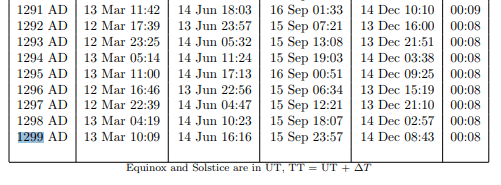 Fig.1 beda.cz: Vernal equinox in 1299 c.e.
The first new moon after March 13, 1299, starts the first month of the Biblical year. The first conjunction after March 13 falls on April 2.
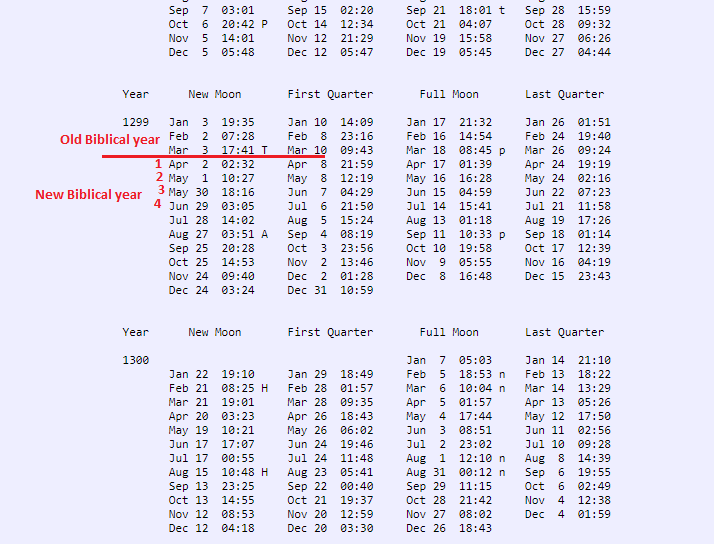 Fig.2 Astropixels: New moon conjunctions for the year 1299
As you can see in the picture above, we can count the number of new moons from the first new moon conjuction of the Biblical year. Since the fifth Biblical month has to start after the conjunction of July 28, we deduce that July 27, which is the first day of Ottoman rule, falls on the fourth Biblical month. The fourth Biblical new moon conjunction fell on June 29, at approximately 3 a.m., Universal Time, which is approximately 5 a.m., Jerusalem time. The first setting of the sun at Jerusalem after this conjunction happened in the evening of June 29; this is the first day of the fourth Biblical month. Counting from June 29 to July 27, we get that July 27, 1299, is the 28th day of the fourth Biblical month. That marks the beginning of the 150 years announced by the fifth trumpet. Therefore, the end of this period falls on the 28th day of the fourth Biblical month, 1449 c.e. In 1449, the vernal equinox fell on March 11, and the fourth Biblical new moon conjunction, on June 20, at approximately 11 a.m., Jerusalem time.
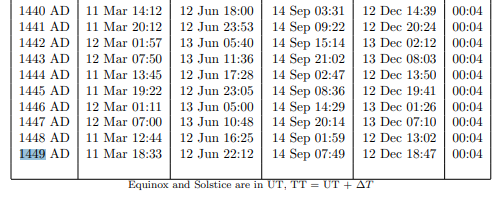 Fig.3 beda.cz: Vernal equinox in 1449
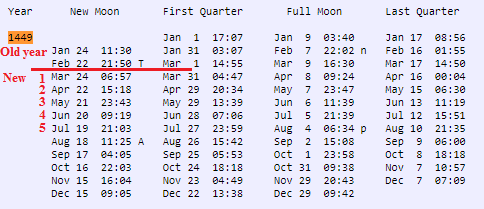 Fig.4 Astropixels: New moon conjunctions in 1449
According to the tables above, the first day of the fourth Biblical month in 1449 is June 21, beginning at the setting of the sun, June 20. So the 28th day of the fourth Biblical month is July 18, 1449, and that's the end of the 150 years.
The 15 Days and 391 Years
And the sixth angel sounded[...] And the four angels were loosed, which were prepared for an hour, and a day, and a month, and a year, for to slay the third part of men. {Revelation 9:13a,15}
Assuming the sixth trumpet begins right after the end of the 150 years announced in the fifth trumpet, that it also concerns the Ottoman Empire, and that the time period referred to in verse 15 is aggregate (an hour plus a day plus a month plus a year), we can start counting this period of time from the 18th of July, 1449. With the day-year principle, we reckon one hour plus a day plus a month plus a year, as the 24th part of a year plus a year plus 30 years plus 360 years. The reason why the month is taken to have exactly 30 days and the years exactly 360 days is the following: all calendars in the world, prior to the 8th century b.c.e, had years with exactly 360 days and 30-day months. At creation, the year had exactly 360 days and 30-day months and at one time it changed. The day-year principle is always based on these ideal times instituted by God at creation. The reason a Biblical day has 24 Biblical hours is because Ellen White says it so.
[...] When the Lord declares that He made the world in six days and rested on the seventh day He means the day of twenty four hours, which He has marked off by the rising and setting of the sun. {Lt 31, 1898, par. 25}
Now, the 24th part of a 360-day year is 15 days. That's because, for the day-year principle, we take an ideal day near an equinox with 24 equal hours. Adding up the "hour, day, month and year", we get a period of 15 days and 391 years, starting from July 18, 1449. It seems nothing remarkable happened on that day in the Ottoman Empire, nor it needs to, because the four angels were loosed
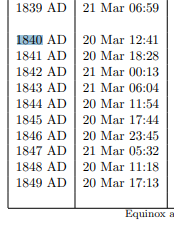
then; when angels start working, we don't necessarily see them. But this working became visible soon after, in 1453, when Mehmet II conquered Constantinople. Then a new phase of Ottoman power was publicly made manifest. But that new phase began quietly, according to the Bible, on July 18, 1449. 15 full days after the 18th of July end on the 2nd of August. Since the fifth conjunction fell on July 19 at approximately 11 p.m. (Jerusalem time), the first day of the fifth Biblical month, 1449, is July 21 (beginning at the setting of the sun, July 20). Therefore, August 2, 1449, is the 13th day of the fifth Biblical month. We're left to add 391 years from this date. That leads us to the 13th day of the fifth Biblical month, 1840.
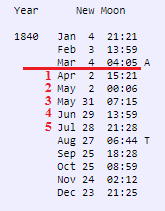
The vernal equinox in 1840 is March 20; the fifth conjunction is on July 28, at approximately 11:30 p.m., Jerusalem time. That means the first day of the fifth Biblical month is July 30 (beginning at even, July 29). Counting from this date, we get that the 13th of the fifth Biblical month is August 11, 1840. This is the date which ends the 15 days and 391 years announced in the sixth trumpet.
What Happened On August 11, 1840
A British newspaper called the Morning Chronicle published on September 3, 1840, a report from August 12, 1840, concerning the situation of the ongoing Ottoman-Egyptian war. You can read the entire issue by accessing this link. Here we provide an excerpt:
[...] nor does a note delivered yesterday by the four ambassadors, in answer to a question put to them by the Porte, as to the plan to be adopted in such an event, throw the least light on the subject. It simply states that provision had been made, and there was no necessity for the Divan alarming itself about any contingency that might afterwards arise.
The context is the following. To stabilize the conflict between Egypt's de facto ruler Muhammad Ali and the Porte (the Ottoman government in Constantinople), the four allied powers of Europe, namely, Great Britain, France, Austria and Russia, convened to take the matter into their own hands in dealing with Ali, treating the administration in Constantinople as a subservient state. The Ottoman government asked the European allied powers what to do in the case Ali won't submit; the response, delivered on August 11, was that provision has been made, and there was no necessity for the Divan alarming itself about any contingency that might afterwards arise.
Since the Divan (Ottoman cabinet) kept its peace after receiving this response, that's an evidence that the Ottoman Empire officially accepted to be placed under the Christian nations on that very day. The Ottoman Empire lasted 82 more years, but from that date, August 11, only as a dependent state under the European allied powers; the Ottoman independence was gone on the very day specified by prophecy.
People back then understood this news was prophetic. William Miller's associate, Josiah Litch, predicted that on August 11 the Ottoman power will be broken, and the people were watching to see whether it would be fulfilled. After receiving the news, the people were convinced this meant that the Ottoman power was crushed on August 11, by the following account:
The event exactly fulfilled the prediction. When it became known, multitudes were convinced of the correctness of the principles of prophetic interpretation adopted by Miller and his associates, and a wonderful impetus was given to the advent movement. Men of learning and position united with Miller, both in preaching and in publishing his views, and from 1840 to 1844 the work rapidly extended. {GC 335.1}
This fulfilment of prophecy is what made the day-year principle trustworthy. Also, inspiration tells us what happened on August 11:
At the very time specified, Turkey, through her ambassadors, accepted the protection of the allied powers of Europe, and thus placed herself under the control of Christian nations. {GC 335.1}
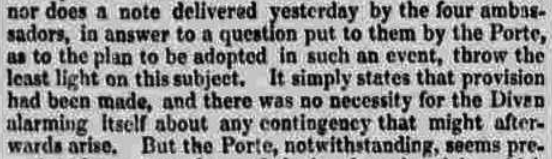 Fig.5 Morning Chronicle: The evidence of the fulfilment of Litch's prediction
Aftermath and Relevance for Us
We provided two witnesses — one historical and one taken from the sacred writings — proving that Josiah Litch's prediction for August 11, 1840, was fulfilled. Furthermore, we provided another method of calculating the periods, than the method used by Litch; and it corroborated the same result. Now, it seems that Litch afterwards discarded his views entirely and that he eventually abandoned his historicist views, separating himself from the "shut-door Adventists", after 1844. His course later in life doesn't make the facts one jot less true though. God led the Advent movement. Neither Litch and not even Miller fully understood all the details involved with their preaching, and we can't expect their logic and arguments to be flawless. Per example, Litch allowed the first period, 150 years, to have been exactly fulfilled before Deacozes ascended the throne by permission of the Turks.
I can't see how this statement could stand, because, assuming it refers to Constantine XI, Palaiologos, he ascended to the throne on January 23, 1449, some six months before the completion of the 150 years. But we proved the 150 years ended on July 18, 1449, assuming we're dealing with complete counting starting from the given date; so we can ignore Litch's argument entirely. Ellen White included an excerpt of Litch's exposition in The Great Controversy, and she did confirm that the event was fulfilled; she didn't necessarily endorse all his statements by quoting him. Also, the Millerites didn't have the light that we have on the Biblical calendar and they just were basing their calculations on the Gregorian calendar, taking the 27th of July from 1299, and adding 15 days to the same 27th of July, 1840, to arrive at August 11. But the calendar of Jehovah is not based on the Gregorian calendar. They got the correct date through wrong methods. That's how you know God was leading the whole thing.
If a wonderful impetus was given to the advent movement
then, through this time prophecy, giving credibility to the day-year principle, we can expect no less impetus to be given to God's modern-day Seventh-Day Advent movement, by consolidating and restoring His calendar. In passing through Revelation 9 here, we skipped many details. That's because we believe it has two applications: the one presented here (historicist), which is partial, and an another one soon to happen (imminentist). More details will become important for us as we'll study the imminentist interpretation. This article is one of many to come, which aim to give certainty of those past teachings that we have sustained and preached as a people, and provides glimpses of and guiding principles for our upcoming studies about the events that are soon to transpire in these last days.